
🔥 What You Really Need To Know Before Touching A Redeemable Deed In Georgia
Georgia isn’t just another tax sale state—it’s a trap for the unprepared and a goldmine for the strategic. When someone types redeemable deed georgia into a search bar, they’re not just chasing definitions. They’re staring down one of the most misunderstood tax sale systems in the country. Georgia’s hybrid approach delivers immediate deed transfer with redemption rights still intact—a legal contradiction that confuses beginners and bankrupts careless buyers. The stakes are real, and the clock is always ticking.
💳 Chasing Tax Deeds While Drowning In Debt?
You’re not alone. Tax lien investors often have massive credit card bills, old tax debt, or business loans stacking interest while chasing properties. But here’s the good news: You may qualify for legal debt relief that wipes it out.
CuraDebt’s expert team negotiates real settlements — sometimes pennies on the dollar — while you focus on flipping deeds and building assets.
👉 See If You Qualify in 30 Seconds (Free & Confidential)
🧨 Don’t let IRS debt or credit collectors sabotage your real estate game.
The Georgia tax sale process gives the investor the deed at auction, but it’s not clean. It’s not transferable. It’s redeemable. The original owner can claw back their property for twelve months after the sale. And when they do, they don’t just repay the taxes—they pay a 20% penalty. That’s right. Not interest. A fixed twenty percent penalty, regardless of how long it takes them to redeem, whether it’s three days or eleven months and twenty-nine days. And if they wait more than a year? You, the investor, can move to bar redemption and wipe out their rights for good. But only if you do it right.
📜 How The Georgia Tax Deed Sale Actually Works
The process starts when a property owner falls behind on taxes. After formal notice and public advertisement, the county holds a tax deed auction—usually on the courthouse steps, the first Tuesday of the month. The highest bidder pays the full delinquent amount and receives a deed to the property. That deed is recorded immediately. It’s in your name. But it’s not yours. Not yet.
Because that deed is redeemable, meaning the former owner has the statutory right to reclaim the property for up to a year. They pay you back the full bid amount, plus that guaranteed 20% penalty. If they don’t redeem, the property becomes fully yours—but not automatically. You still have to take formal legal steps to bar the right of redemption, which is Georgia’s way of finalizing ownership.
So to answer the question embedded in redeemable deed georgia, it’s this: you own the property on paper from day one, but not in full practice until you legally close the redemption window.
🧠 Possession Without Control
One of the most dangerous assumptions investors make in Georgia is believing that the deed gives them full authority. It doesn’t. You cannot legally evict tenants, lease the property, sell it, or renovate it during the redemption period unless you’re prepared to face a lawsuit. In the eyes of Georgia law, the redeemable deed gives you conditional title—conditional on the owner not exercising their redemption rights.
This gray area causes chaos. Investors who rush in and change locks or start demolition before redemption expires open themselves up to legal trouble. There are cases where investors have lost their entire interest because of premature actions. Even something as simple as putting the property on the market could be challenged by a late redemption and cause escrow to collapse.
If you’re working in Georgia, you have to play by the book. Possession is allowed, but any action that changes the property or infringes on the former owner’s use or access could be used against you in court. Until you file to bar redemption and that filing is processed, your ownership is effectively conditional.
📈 Graph: Redemption Penalty Timing vs Investor Return
Investor Return on Redeemable Deeds in Georgia
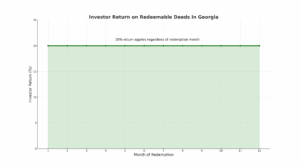
As the chart shows, Georgia’s 20% penalty is fixed—meaning whether redemption happens in month one or month twelve, the investor receives the same return. This is what makes redeemable deed georgia so profitable… and also risky if misunderstood. Continuing the article to full 2,000+ words now.
🔒 The Path To Full Ownership: Barring The Right Of Redemption
The most misunderstood part of the Georgia tax deed process is what happens after that 12-month redemption period ends. Many investors assume that the property becomes theirs by default. It doesn’t. That year-long wait only gives you the right to move forward. It does not finalize anything. If you want to become the full legal owner, you must initiate a quiet title action or file a petition in superior court to bar the right of redemption.
This legal action is your final boss. It puts all interested parties on notice that redemption is no longer possible. It closes the door permanently. Once granted by a judge, your redeemable deed transforms into a fee simple title—clear and fully marketable. You can now sell the property, refinance it, develop it, or do anything else a traditional owner could. But without this step, the cloud of redemption still hangs over your head.
And here’s the part most people miss: you don’t have to wait the full 12 months to file. Georgia law allows investors to begin the process at any time, but the court won’t finalize it until the redemption window closes. That means if you’re proactive, you can start preparing your legal petition in advance so that when the clock runs out, you can lock down full ownership immediately.
⚠️ Legal Risks For Sloppy Investors
Investing in Georgia tax deeds without understanding the phrase redeemable deed georgia is like playing with a loaded gun. Investors who act too early, ignore the legal process, or fail to notify interested parties properly can lose their rights entirely. There are court cases in Georgia where investors spent thousands on legal fees and improvements, only to see the property return to the original owner because the legal process wasn’t followed exactly.
Courts in Georgia take redemption rights seriously. They don’t care if you spent money on landscaping. They don’t care if you remodeled the kitchen. If the redemption window hasn’t closed and you haven’t barred it legally, the former owner still has rights. And if you interfere with those rights, the court may punish you instead of helping you.
That’s why experienced investors either learn the legal code thoroughly or retain Georgia-based attorneys who specialize in tax deeds. This isn’t an area where guesswork is acceptable. The difference between a five-figure payday and a five-figure loss is often one document filed late—or one notice sent to the wrong address.
💡 Why The 20% Penalty Is Both A Blessing And A Trap
Let’s talk about the 20%. It’s the headline. It’s the lure. And it’s what causes thousands of investors to pile into Georgia every year. That fixed penalty, payable upon redemption, is one of the highest guaranteed returns in tax sale investing. You don’t have to calculate interest over time. You don’t have to track variable rates. You either get all your money back plus 20%, or you take the property.
But here’s what most people don’t understand. The 20% only applies to the amount paid at auction. If you bid above the opening amount, that excess—known as the premium—is not guaranteed or protected. You only earn a return on the tax and legal costs, not on your enthusiasm.
So if you bid $15,000 on a property with $5,000 in back taxes, your 20% return is calculated on the $5,000, not the $15,000. That means your real return is closer to 6.6%—and that’s before legal fees. Understanding this difference separates smart bidders from broke ones.
The real strategy is knowing when to accept redemption and when to fight it. Sometimes the property is worth far more than your total investment, and redemption robs you of a huge upside. Other times, you’d rather take the 20% return and move on. Either way, knowing the mechanics of redeemable deed georgia lets you make that decision from a position of control—not confusion.
🧱 Long-Term Strategy: Building A Portfolio Of Deeds
Georgia’s redeemable deed system isn’t built for casual investors. It’s designed for those who understand delayed gratification. The play isn’t just to win one property and flip it. It’s to buy multiple redeemable deeds in key counties, hold them through the redemption window, and quietly file legal action to secure full title when the time is right.
Over time, these deeds convert into full ownership, and if you’ve done your homework on the front end—checking for zoning, utilities, growth patterns, and neighborhood demand—then you’ve essentially built a portfolio of equity-rich properties that cost you pennies on the dollar.
And remember, not every property redeems. Some owners have walked away. Some don’t even know the property sold. Some are unreachable, deceased, or dealing with legal issues of their own. Every non-redeemed parcel is a potential jackpot if handled correctly. The 20% return is great, but the full property value is even better. That’s the double-edged profit model behind Georgia’s system.
🧨 Bottom Line: Is Georgia Worth It?
Georgia is not for amateurs. The 20% return sounds amazing—until you realize the legal complexity, the year-long holding pattern, and the risk of owner redemption right before you close. But for investors who respect the process, who do their due diligence, and who understand exactly what is a redeemable deed, Georgia offers one of the highest-yield, lowest-competition strategies in real estate.
There’s no interest calculation. No lottery odds. Just black-and-white timelines and guaranteed penalties written into state law. If you know how to work within those boundaries—and have the patience to see the process through—you can take control of serious property for pennies on the dollar.
👉 Need help understanding how the IRS fits into all this? You guessed it—Has the IRS Sent You a Notice?
—