
🔍 What Makes Tennessee Different From Other States?
Tax sale laws across the United States follow a few familiar patterns. Some states sell lien certificates, others auction off deeds. But if you’re searching for answers to what is a redeemable deed, there’s no better example than Tennessee. Tennessee’s system doesn’t just stand out—it sits squarely in the middle of both approaches. The state issues redeemable tax deeds, which means you get ownership of the property when you buy at auction, but the original owner retains the right to redeem it within a strict window of time.
Unlike traditional lien states where investors are merely hoping to earn interest on a certificate, or deed states where ownership transfers immediately, Tennessee gives the investor possession but not finality. This hybrid structure throws off many new buyers, and if you don’t fully understand what a redeemable deed means in this context, you’ll either miss opportunities or walk straight into legal and financial disaster.
💳 Chasing Tax Deeds While Drowning In Debt?
You’re not alone. Tax lien investors often have massive credit card bills, old tax debt, or business loans stacking interest while chasing properties. But here’s the good news: You may qualify for legal debt relief that wipes it out.
CuraDebt’s expert team negotiates real settlements — sometimes pennies on the dollar — while you focus on flipping deeds and building assets.
👉 See If You Qualify in 30 Seconds (Free & Confidential)
🧨 Don’t let IRS debt or credit collectors sabotage your real estate game.
In Tennessee, the county government initiates a tax sale when property taxes go unpaid for at least one year. That timeline can vary slightly by jurisdiction, but the process usually starts with notice of delinquency, followed by legal proceedings that culminate in a court-ordered auction. The investor bidding at that auction is not purchasing a lien. They’re receiving a deed—but that deed is redeemable. The former owner has one year from the date of confirmation of sale to redeem the property. And during that time, the investor can’t sell, transfer, or materially alter the property unless they want to face legal consequences.
So when we talk about what is a redeemable deed, we’re really talking about this limbo status—where you hold the deed in name, but not yet in full legal practice.
🧠 Redemption Window and Ownership Rights
Once you win a Tennessee tax deed auction, you have to wait. For a full year, the original owner has the legal right to redeem the property by reimbursing you for the full bid price, court costs, and interest. That interest rate is fixed at 10%, and it accrues from the day of sale to the day of redemption.
You can take possession of the property after the court confirms the sale, but it’s possession with boundaries. You cannot demolish, improve, or permanently alter the structure. You can’t evict occupants without legal justification, and you absolutely can’t flip or sell the property until the redemption window closes. This makes it very different from traditional deed states like Arkansas or New Mexico, where ownership is immediate and permanent once you win the auction.
Understanding what is a redeemable deed in Tennessee means understanding you are in a waiting game. A profitable one, yes, but a waiting game nonetheless. If the owner redeems, you walk away with your money plus 10%. If they don’t, you move to clear the title and proceed with full ownership rights. But that doesn’t happen automatically. You’ll need to understand how to navigate quiet title actions or judicial clearance processes before you can truly claim the property clean.
💼 Legal Nuance Behind the Deed
Many investors make the mistake of thinking “deed” means full title. In Tennessee, that’s not true until the redemption window expires. What you hold is a clouded title. You have legal standing, but that title cannot be transferred cleanly without judicial resolution if the property is ever to be sold or refinanced.
So let’s be clear. The answer to what is a redeemable deed is not just “a deed that can be reversed.” It’s a deed that exists in a legal state of flux—a temporary position that carries significant rights but also limits. The deed grants the investor possession, the potential for future ownership, and interest return upon redemption. It does not grant finality, immediate resale value, or immunity from legal action if improperly handled.
📊 Graph: Redemption Timeline and Investor Outcomes
Likelihood of Redemption Over Time in Tennessee
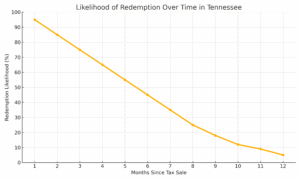
The graph shows how the likelihood of redemption drops steeply over time—starting near certainty and falling below 10% by month twelve. Understanding this arc is crucial for investors navigating Tennessee’s redeemable deed process. Now continuing with the full article.
🏚️ The Real Risk Behind Redeemable Deeds
One of the most overlooked facts about Tennessee’s tax deed system is that the property you win at auction may be worthless in practice during the redemption period. Investors get lured by the promise of cheap ownership only to find themselves handcuffed by legal restrictions. You can’t sell it. You can’t flip it. You can’t even renovate it until you know for certain the owner won’t redeem.
If you buy a structure with code violations, you’re responsible for maintenance—but you can’t make major improvements. If it’s a rental property, you may face tenant disputes even though the deed is technically in your name. And if the property gets vandalized or damaged during that redemption period, you carry the burden—not the former owner.
Understanding what is a redeemable deed also means understanding your liability. Tennessee law doesn’t grant immunity to deed holders if they mishandle possession. That includes unauthorized evictions, unsafe occupancy decisions, or even failure to comply with local housing codes. The county doesn’t offer legal support. You’re on your own.
That’s why some of the savviest investors in Tennessee avoid occupied properties altogether and go after land parcels or abandoned homes. Raw land may not bring immediate returns, but it carries far fewer legal headaches. An empty parcel isn’t going to fight you in court or file complaints with the code enforcement office.
🧱 Quiet Title And What Happens After Redemption Expires
If the former owner fails to redeem within one year, you now have the right to make your ownership permanent. But make no mistake—there’s still more work to be done. At this point, you need to begin a process called quiet title, which is a judicial action that clears any clouds on the deed and confirms your ownership in the eyes of title companies and future buyers.
Without this step, you’ll find that even though the county recognizes your deed, the broader legal system may not. Lenders won’t fund it. Buyers won’t buy it. Title companies won’t insure it. And you could be sitting on a property that you technically own, but legally can’t use.
The quiet title process varies in length and complexity depending on the county and property history. In some cases, it can be completed in a few months. In others, it may require litigation, court appearances, or negotiation with third parties who have an interest in the property. That’s why many tax deed investors in Tennessee factor in an additional six to twelve months beyond the redemption period before considering the property truly theirs.
💡 Why This System Works For Smart Investors
So why do people still invest in redeemable deeds in Tennessee? Because the balance of risk and reward, when properly understood, heavily favors the educated buyer. If you know what you’re doing—if you research the property beforehand, verify its zoning and condition, confirm its value, and understand the local redemption and title processes—you can acquire property at a fraction of its market value.
If the owner redeems, you collect a 10% return, which in today’s economy is better than most stock portfolios. If the owner doesn’t redeem, and you navigate the legal process correctly, you could acquire full ownership of a property worth two to ten times what you paid. And since many bidders are scared off by the redemption system, the competition at Tennessee tax sales is significantly lower than in flashier states like Texas or Florida.
This opens the door for committed investors to build a powerful portfolio—one that starts with risk but ends with long-term equity and passive appreciation.
🔎 The Key Takeaway
You don’t win in Tennessee by guessing or gambling. You win by knowing exactly what is being offered at every stage of the process. When you ask what is a redeemable deed, the answer isn’t just legal—it’s strategic. It’s a contract between you, the county, and the former owner, where every party has rights and every deadline matters.
If you treat the deed like an asset before it legally is one, you lose. But if you treat it like a claim—one that must be validated, protected, and eventually cleared—then you walk away with an asset that few others had the patience or expertise to claim.
👉 If the IRS has added its own layers of confusion with notices, audits, or collection threats, start here: Has the IRS Sent You a Notice?