💥 What Makes Utah Different From Other States?
When most investors hear about tax sales, they immediately think of lien certificates in Florida or redemption deeds in Texas. But tax liens utah are a whole different beast. Utah is a pure tax deed state, which means when you win a bid at the county tax sale, you’re not buying a lien—you’re buying the property outright. That sounds powerful, right? It is. But it’s also loaded with risk if you don’t know what you’re walking into.
The process starts with unpaid property taxes. If a property owner fails to pay, the county waits five years—yes, five—before it takes action. After that, it doesn’t auction off a lien. Instead, it auctions off the entire property deed to the highest bidder. You’re getting the real deal: ownership, title (sort of), and liability all in one package.
That’s why every investor googling tax liens utah needs to understand this: you’re not just buying opportunity. You’re buying responsibility. If you don’t do due diligence, it could financially gut you.
💳 Chasing Tax Deeds While Drowning In Debt?
You’re not alone. Tax lien investors often have massive credit card bills, old tax debt, or business loans stacking interest while chasing properties. But here’s the good news: You may qualify for legal debt relief that wipes it out.
CuraDebt’s expert team negotiates real settlements — sometimes pennies on the dollar — while you focus on flipping deeds and building assets.
👉 See If You Qualify in 30 Seconds (Free & Confidential)
🧨 Don’t let IRS debt or credit collectors sabotage your real estate game.
⏱️ How Long Until You Own It?
Utah has no post-sale redemption period. That means the moment the sale is finalized and your payment clears, the county deed is coming your way. In some other states, the former owner has months—or even years—to pay you off and redeem the property. But not in Utah.
For some investors, that’s a dream. For others, it’s a nightmare. If you accidentally bought a teardown with liens and zoning violations, tough luck. That’s why researching every parcel before bidding is not optional—it’s survival.
🏛️ How The Utah Tax Deed Sale Process Works
Each county in Utah handles its own tax sale. Typically, sales are held once a year—most often in May or June—but exact dates vary by jurisdiction. Here’s what happens:
The county publishes a list of delinquent parcels. These are the properties that haven’t had taxes paid in at least five years. Then, they post a notice of the upcoming public auction, giving investors time to review the list.
Most counties require pre-registration to bid. Some use in-person bidding, while others may offer online auctions through third-party platforms. The opening bid is usually the amount of delinquent taxes owed, plus administrative fees. But from there, it can escalate fast.
📊 Here’s a sample table comparing counties:
| County | Online Auction | Min. Bid | Redemption Period | Title Warranty |
|---|---|---|---|---|
| Salt Lake | No | Delinquent Taxes + Fees | None | Quitclaim Only |
| Utah County | Yes (GovEase) | Delinquent Taxes + Fees | None | Quitclaim Only |
| Washington | No | Delinquent Taxes + Fees | None | Quitclaim Only |
| Weber | Yes | Varies | None | Quitclaim Only |
As you can see, there’s no redemption period in any of Utah’s counties. Once you buy it, it’s yours. But you’re not getting a clean title. You’re getting a quitclaim deed, which means you inherit all encumbrances unless you clear them through a legal action called quiet title.
🧠 What About Existing Mortgages Or Liens?
Most county treasurers will tell you that mortgages get wiped out at the tax deed sale. That’s true in theory—but not always in practice. IRS liens, city utility liens, code enforcement fines, and even HOA debts may survive the sale depending on how the property is structured.
If you think tax liens utah are simple, think again. Each parcel is a legal minefield, and many of the most “affordable” options come with massive baggage. You could inherit a property with thousands in unpaid sewer bills or a lawsuit from a previous contractor. That’s why seasoned investors always run:
A title search, a visual inspection, and a check for zoning violations before they bid a single dollar. If you skip these steps, you’re gambling, not investing.
🏚️ Occupied Properties: Your Problem Now
Let’s say you win a property at the tax sale and discover it’s still occupied. Now what?
Unfortunately, that’s your problem. Utah doesn’t evict former owners for you. You have to go through civil eviction proceedings yourself, which can take months—and cost thousands in legal fees. If the occupant doesn’t leave peacefully, you’re stuck until the court sides with you.
Even worse, if it’s a tenant, they may have renters’ rights under Utah law. That means you may not be able to immediately remove them, even though you own the property. And if the house is in bad shape? You’re now liable for code violations, property maintenance, and safety compliance.
So while tax liens utah searches might promise passive returns, real tax deed investing in Utah is anything but passive.
💸 Is It Worth The Risk?
That depends on your strategy.
For flippers and developers, Utah tax deeds can be gold mines—especially in counties with high growth like Utah County, Washington County, and Cache County. Buying raw land at auction and rezoning it later is one way to triple your money.
But for passive investors looking for low-risk cash flow, Utah may not be the best match. You’re not collecting interest on a lien here—you’re acquiring real property, which means real responsibility.
🧾 Tax Deed vs Tax Lien: Know The Difference
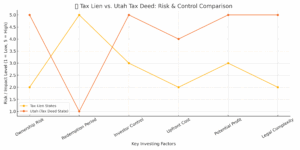
Here’s a simplified breakdown to understand why your tax liens utah query really needs to focus on deeds, not liens:
| Feature | Tax Lien State | Utah (Tax Deed State) |
|---|---|---|
| What You Buy | A lien (IOU on property) | Full ownership of property |
| Interest Earned | Yes | No |
| Ownership Transfer | Only if not redeemed | Immediate after sale |
| Redemption Period | 6–36 months | None |
| Risk Level | Low–Moderate | High |
In Utah, there is no return if you lose. There is no interest rate cushion. You’re not lending to a homeowner—you’re buying their entire asset, for better or worse.
📈 Recent Trends And Market Insights
Utah’s population growth and booming real estate market have turned tax deed auctions into competitive battlegrounds. Over the past five years, counties like Salt Lake, Utah, and Davis have seen a surge in investor participation. Some auctions now have over 100 bidders on popular parcels.
If you’re serious about this space, you need to:
Review the auction list early (usually released 4–6 weeks before the sale), conduct deep due diligence, prepare your funding in advance, and understand county-specific rules.
And never assume a property is a “deal” just because the minimum bid is low. That’s the bait. The trap is hidden in liens, structures, lawsuits, and red tape.
🔍 Where To Find Official Listings
Each county runs its own sale, usually once per year. You’ll find auction information on county websites, treasurer pages, or through platforms like GovEase or Bid4Assets, if the county uses a third-party platform.
Start with the Utah State Tax Commission or your local county treasurer’s office to view:
Upcoming sale dates, rules for bidders, parcel maps, and payment instructions.
You can also dig deeper into parcel data using public records, GIS maps, and land records databases. Serious investors create spreadsheets of each parcel, with red/yellow/green risk ratings.
🧨 Final Warning Before You Bid
If you don’t know how to quiet a title, you’ll never sell the property. If you don’t research environmental or zoning issues, you could buy worthless land. If you ignore structural damage or unpaid HOA dues, you may be buying a lawsuit.
Tax deed investing in Utah is not for dabblers. It’s not passive income. It’s a full-contact sport, and if you don’t know how to fight, you’ll get wrecked.
👉 Start here: Has the IRS Sent You a Notice? 👈
📰 Breaking Auction Updates & Press
Utah County Tax Deed Auction Features